Challenges and Opportunities

As the feedback from stakeholders is a crucial factor in driving a sustainable business according to stakeholders are exactly impacted both positive and negative from the business operation. The Company thus places importance on engaging long-term relationships with its stakeholders to appropriately respond to the expectations and global circumstances.

Supporting the SDGs
Targets and Performance Highlights

  • Long-Term Target by 2030

    • Stakeholder engagement score at least 80%

  • 2025 Target

    • Stakeholder engagement score at least 80%
  • 2025 Performance

    88% score from Stakeholder’s ESG engagement survey

    External stakeholder engagement score is 93%

    Employee engagement score is 85%

    Customer satisfaction score is 86%

Management Approach and Value Creation

The company realizes that the distinct perspectives from different stakeholder groups are vital to mitigating business risks and the impacts of the operation, improving operational efficiency and creating shared values for all parties involved. The AA 10000 Stakeholder Engagement Standard is applied to form effective engagements with 10 stakeholder groups along with appropriate participation channels for each group. The channels are reviewed annually both quantitative and qualitative input including ensure that stakeholder voices are the input for the Company's materiality review and risk assessment.

Annual Stakeholders ESG Engagement Survey

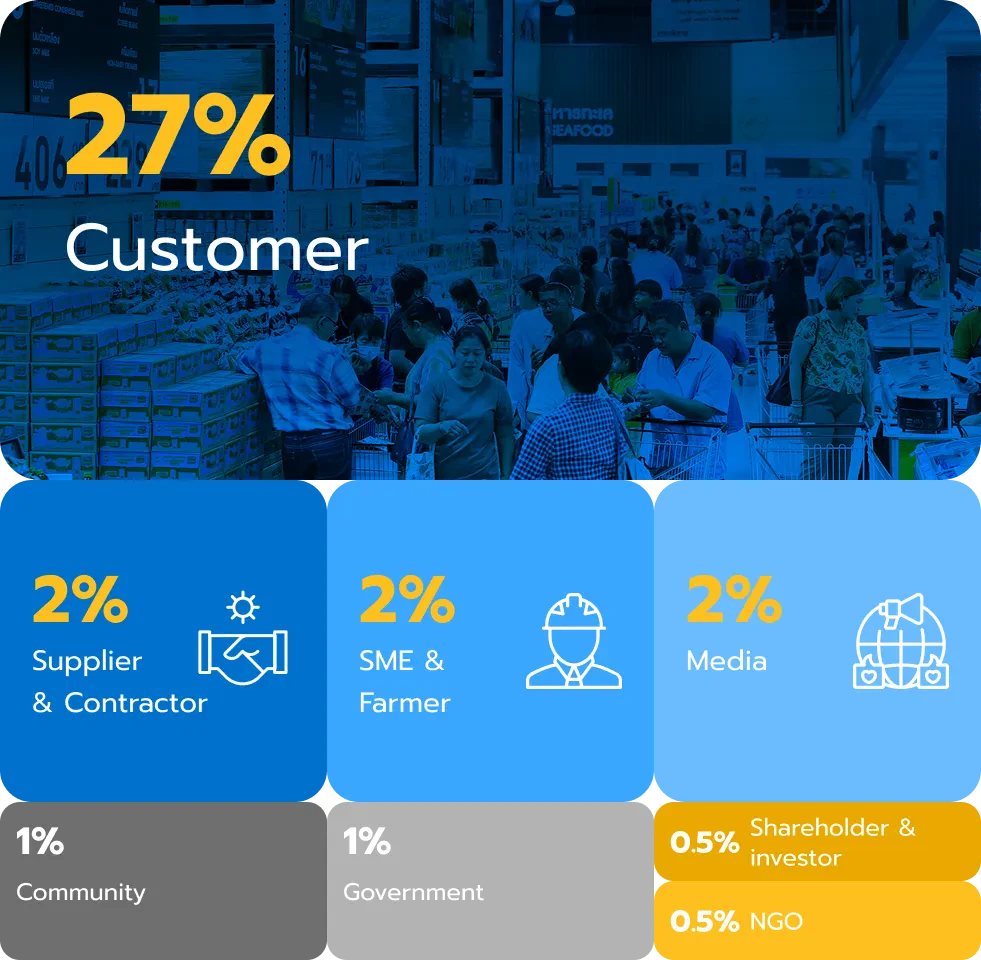
In March 2025, the annual stakeholder engagement survey from 781 people as
Stakeholder Engagement Score
Target

2025

80%
Customer Satisfaction Score (%)
Target

2025

85%

Online Customer and Revenue

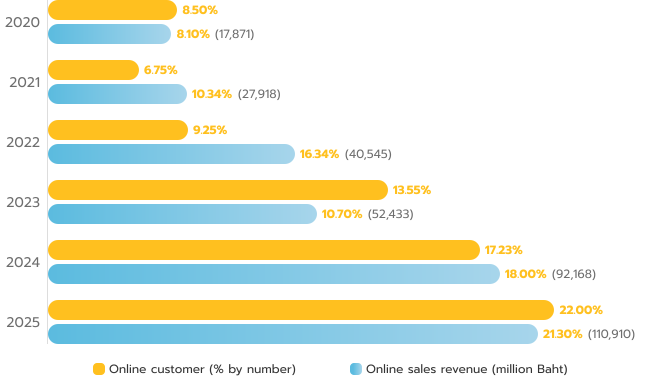
The company recognizes the importance of the online and cashless society including covid-19 pandemic changed consumer behaviour and their expectation for more convenience and faster service. This challenge represents the opportunity for the company, to develop omnichannel sales and services under the online to the offline platform which are dramatical growth in both the number of customers and sales revenue.

2025 Target

Online Customer

> 15%

Online Sale Revenue

> 15%
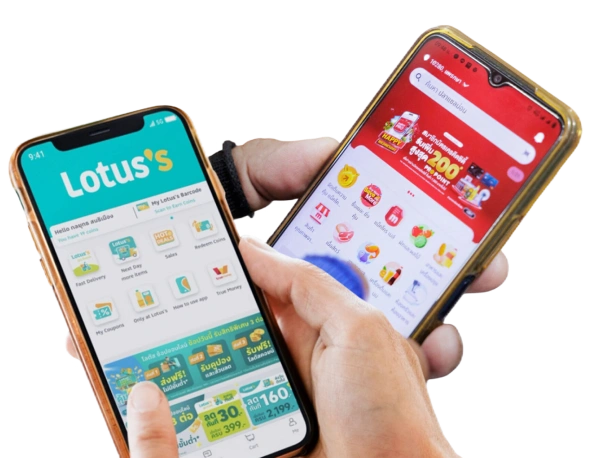
ตัวอย่างการใช้งานช่องทางออนไลน์บนโทรศัพท์มือถือ

Identify the Material Issue from Stakeholder Engagement Channels

The feedback from the variable engagement channel will be collected and considered to the material issue. The negative feedback i.e., complaint, number of breach case, incident etc. The result will be counted as the negative issue. In the other hand, the positive feedback as suggestion and expectation from external stakeholder are considered either. Also-the performance gap or significant-change-that potentially impact-to-ESG-management system-such-as-the-migrant-worker-hiring-in-store which-are-review-for-human-rights non-discrimination, labor practice and living wage and safe work condition etc.

Stakeholder Engagement Channels Expectations / Impact / Performance gap Materiality Issue
Shareholders and Investors (External Stakeholder)
  • Annual General Meeting of Shareholders (AGM).
  • Quarterly Analysts Meeting.
  • Investor meeting.
  • Accurate, complete, and timely information disclosure.
  • Transparency Management.
  • Protect shareholder's rights.
  • Business growth & Competitiveness.
  • Comply with Stock market's new CG and transparency disclosure.
  • Corporate Governance.
  • Stakeholder engagement.
  • Innovation product & service.
  • Cybersecurity & data privacy.
Employees (Internal Stakeholder)
  • Annual ESG engagement survey.
  • Whistleblowing, Suggestion box, website, and hotline.
  • Annual employee engagement survey.
  • Quarterly meetings of Welfare Committee.
  • Benefit, Welfare, Compensation, and Career
  • Growth Safe working condition and equipment..
  • Work Life Balance and Flexible working hours.
  • Upskill and reskill for modern competency.
  • Equality, non-discrimination diversity and inclusion for migrant worker at store.
  • Human rights-Non Discrimination.
  • Health & Safety.
  • Human capital development.
  • Human rights - migrant workers at store (NEW).
  • Human rights - Discrimination (NEW).
Customers (External Stakeholder)
  • Annual ESG engagement survey.
  • Complaint channels as website, customer service call center and customer interviews.
  • Ontime delivery with safe, quality and promote health.
  • Affordable food prices.
  • Stock availability.
  • Reliable & traceable product label & information.
  • Personal data protection.
  • Product and service that support the competitiveness.
  • Supply chain management.
  • Health & Well Being product.
  • Innovative product & service.
  • Cyber security and data privacy.
  • Education & inequality reduction.
Suppliers (External Stakeholder)
  • Annual ESG engagement survey.
  • Supplier audit and capacity-building program.
  • Onsite visits and audits.
  • Support agricultural products local SME and farmer.
  • Fairness and transparency supplier selection process.
  • Better understand the certified sustainable agriculture product requirement.
  • Job creation and local SME and farmer.
  • Stakeholder engagement.
  • Supply chain management.
Contractors (External Stakeholder)
  • Annual ESG engagement survey
  • Complaint and suggestions channels.
  • Monthly meeting.
  • Onsite visits.
  • Selection and encourage business partners with transparency.
  • Better understand the human rights and labor practice in Supplier's Code of Conduct manual.
  • Knowledge sharing for road accident prevention.
  • Job creation for small local service company and worker.
  • Supply chain management.
  • Human rights & Labor practice.
  • Health & Safety - Road safety.
Community and Society (External Stakeholder)
  • Annual ESG engagement survey.· Communication channels via Makro’s website, social media, call center.
  • Complaint channels for suggestions and complaints.
  • Dialogue / Monthly visits.
  • Collaborative with local firms to develop and support communities.
  • Job and carrier opportunities for local community members.
  • Protection of accident and environmental impaction the community.
  • CSR activities / donations / continuous support for disaster.
  • Support for student's education in community.
  • Social impact Job creation and economy contribution.
  • Waste water & waste management.
  • Health & Safety.
  • Food security and access to nutrition.
  • Education & inequality reduction.
Financial Institutions (External Stakeholder)
  • Key contact email and phone number.
  • Regular meetings.
  • Performance reports such as annual reports and financial statements.
  • Strict compliance with accuracy, transparency, and punctuality principles.
  • Compliance with contractual terms and conditions.
  • Climate change target and action.
  • Encourage environmental and social support to local farmer.
  • Corporate Governance.
  • Job creation and economy impact to local.
  • Climate resilience and GHG reduction.
Government (External Stakeholder)
  • Organize meetings with the government agencies.
  • Open for government agencies visits.
  • Collaborative agreements with government agencies.
  • Compliance with target and regulation.
  • Support activities beneficial to the community, society, and the environment.
  • Encourage BCG Model and protect natural resource.
  • Encourage and protection of human right in among value chain.
  • Collaboration to prevent food shortage from demand and supply including control or reduce price for end user during economic concern.
  • Corporate Governance:
  • Supply chain management.
  • Human Rights & Labor Practice.
  • Circular Economy.
  • Climate Resilience.
  • Water stewardship.
  • Food security & Access to Nutrition.
Media (External Stakeholder)
  • Annual ESG engagement survey.
  • Communication channels such as website, social media, email, and TV programs.
  • Interview press releases.
  • Communicate relevant, factual, and timely performance.
  • Strategy for business impact on the economy and society.
  • Corporate governance transparent.
  • Social impact and economic contribution.
ESG Rating Agency & NGO (External Stakeholder)
  • Meetings to discuss and exchange information.
  • Research and discussion.
  • Participate disclosure and rating program.
  • Human rights along supply chain.
  • Supplier screening with ESG criteria.
  • Carbon reduction strategy in own operation and supply chain.
  • TNFD disclosure.
  • Prevent ocean plastic waste.
  • Promote the gender equity in supply chain.
  • Supply chain management.
  • Climate resilience.
  • Sustainable packaging.
  • Biodiversity & ecosystem protection.
  • Human rights - Indigenous (New).
  • Human rights - Non discrimination in the supply chain (New).